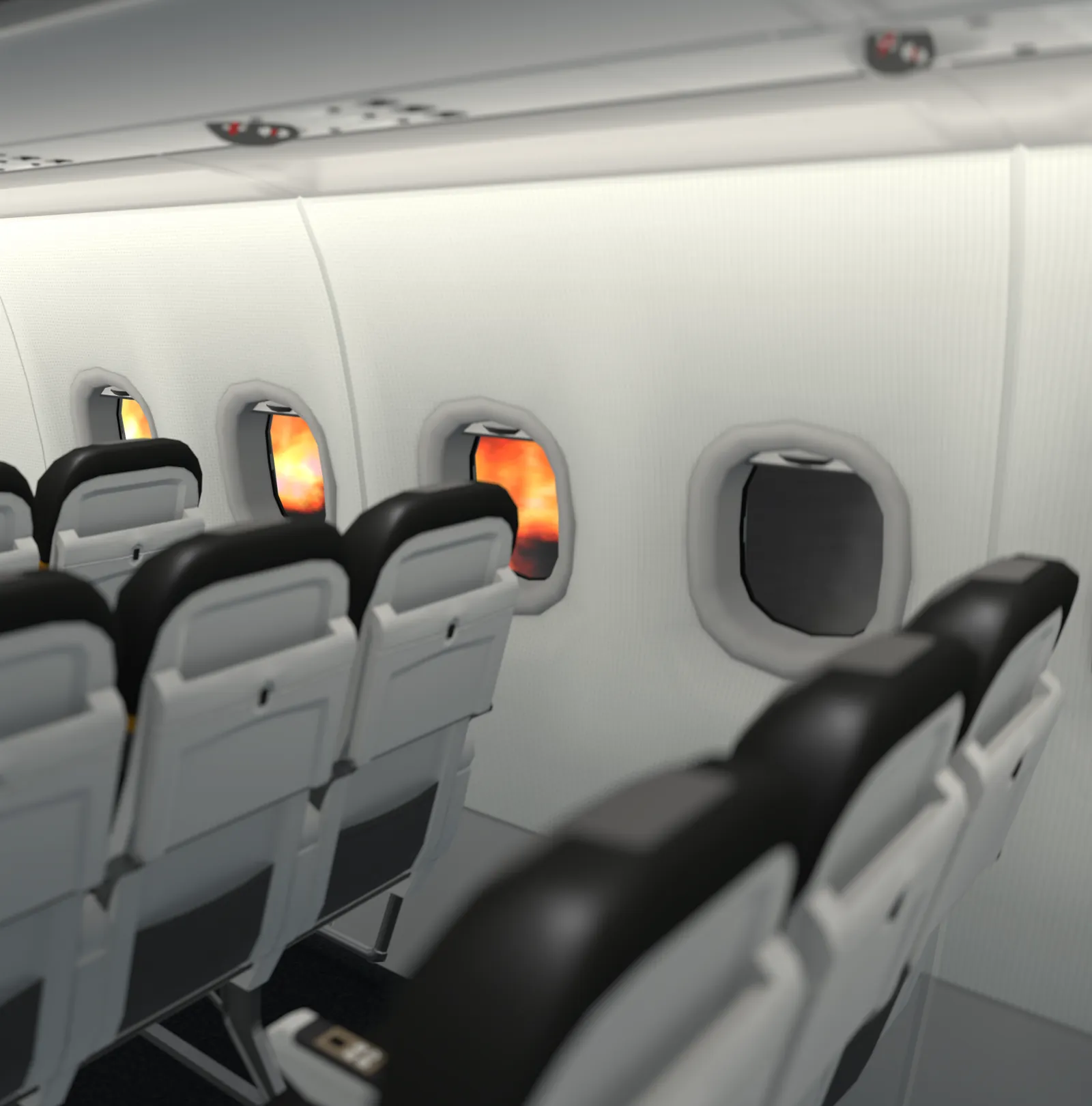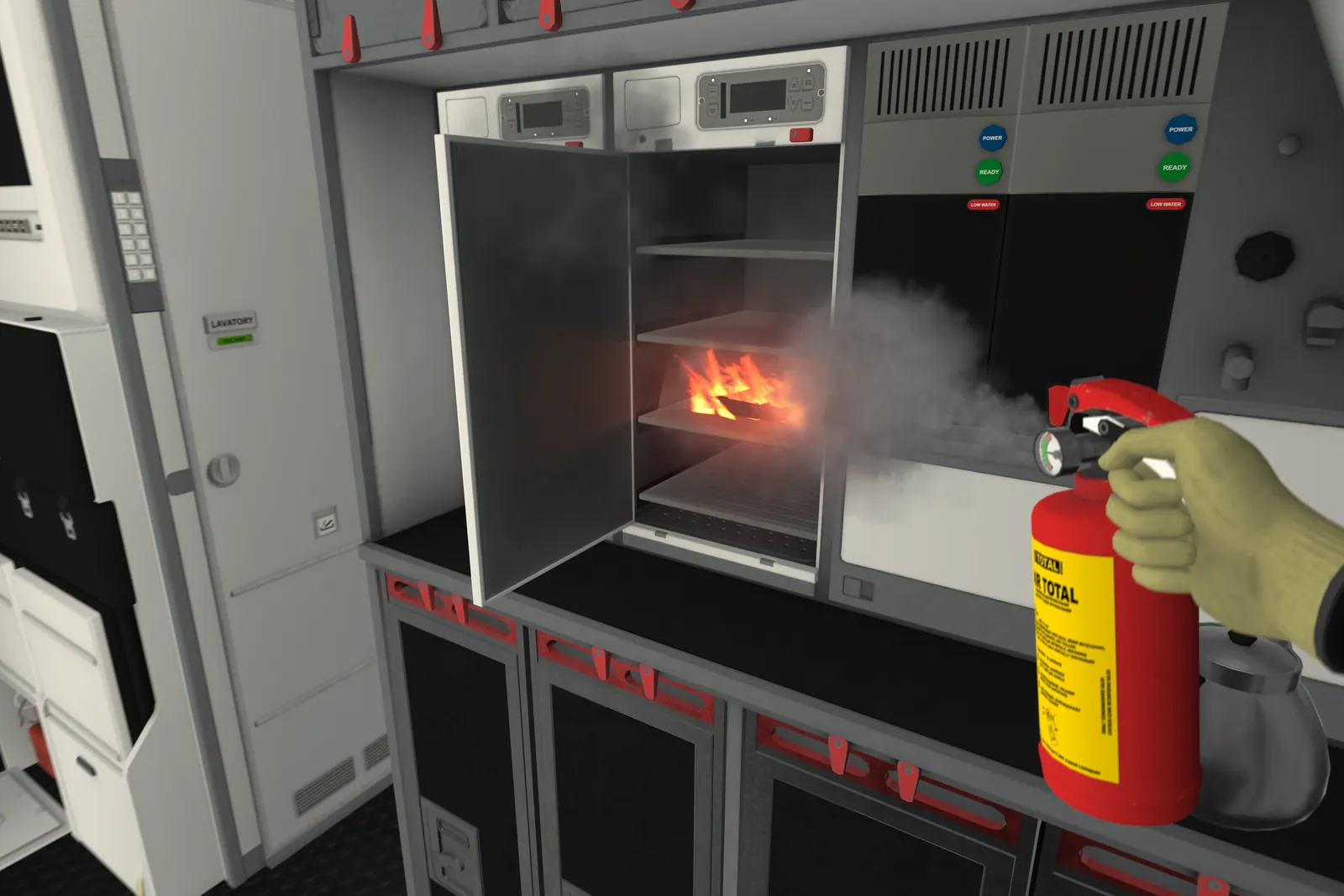
Real extinguisher, radiant heat
AirVR Fire Trainer
Firefighting drills with the weight of a real extinguisher and radiant heat from the fire, without an open flame.
See the Fire Trainer →AirVR Door Trainer
Forces measured on the real aircraft, replayed by a collaborative robot inside a VR cabin. Hands-on door training for any aircraft type, in six square metres at your base.
“By combining virtual reality with real physical resistance, this door trainer simulates a lifelike experience. That makes the training more efficient and above all more realistic.”
AirVR training is in approved use with airlines under the Dutch, Italian, Danish and Swedish authorities; the robot door trainer under the Dutch and Italian.
A headset is very good at procedure and very bad at resistance. A trainee who reaches for a handle in VR closes their hand on air. So we put a real handle where the virtual one is, and a robot behind it.
For every door we measure the handle and door forces on the real aircraft, through its whole travel, and build a force profile from them.
A Universal Robots UR30 holds the handle. Its force loop runs five hundred times a second, so the handle resists, gives and releases exactly where the real one does.
The trainee sees a digital twin of your aircraft and works to your SOPs. Every step, attempt and time is recorded for the instructor.

Boeing 737 MAX 10
TUI has chosen AirVR to train its crew on the MAX 10 mid-cabin exit. One robot, a fraction of the cost of a full door trainer, and ready before your first delivery.
MAX 10 door trainingGalley doors and the 737 MAX 10 mid-cabin exit, switched in software. A new aircraft type is a new force profile and a new cabin, not a new mock-up.
Available every day in a room you already have, instead of competing for an aircraft or travelling to a full-size trainer.
Armed and disarmed doors, power-assist failure, a jammed door and external fire, run with or without guidance to match each trainee’s experience.
Who trained, when, with which instructor, how many attempts, how long each took and whether it was passed, ready for your LMS and your auditors.
Instructor mode guides the trainee through the steps by audio, so instructors can coach communication, decision making and crew coordination.
A collaborative robot built to ISO/TS 15066 and ISO 10218, moving only on the far side of the door the trainee sees, with an emergency stop in the instructor’s reach.
Every deployment is built with your instructors, not handed over. Your subject matter experts sign off the configuration, and every change is traceable to a request.
Weeks 1 to 2
Photographs and video of your aircraft, cabin drawings, placards and the relevant crew manual pages. A named project lead on each side.
Weeks 2 to 3
A first version of your door, cabin and procedure, in your instructors’ headsets within two weeks of intake.
Weeks 3 to 6
Your instructors run it, log every difference from the aircraft and the SOP, and we rebuild until they confirm it matches the aircraft.
Weeks 6 to 7
The robot is installed at your base and integrated with the locked VR configuration, with safety checks end to end.
Week 8
A week with your instructors tuning the handle against your reference and signing the unit off internally.
Typically weeks 9 to 12
We help you prepare the documentation, run the demonstration for your authority, and work through any findings with you until acceptance.
Robot-in-a-box
The mobile AirVR Door Trainer, first shown at EATS 2026. It ships on a single pallet and unfolds into a working door trainer.
See the Robot-in-a-boxReal extinguisher, radiant heat
Firefighting drills with the weight of a real extinguisher and radiant heat from the fire, without an open flame.
See the Fire Trainer →Runs on a standalone VR headset
Cabin visit, fire, door, security search, and evacuation and ditching drills on a standalone headset. No robot, no heater, no room to fit out.
See the Headset Drills →Bo Bennekov, 5 min read
Virtual reality is very good at teaching a procedure and very bad at teaching resistance. Aircraft doors need both. This is how we put the force back.
Get started
Tell us your fleet and which doors you train. We reply by email to agree a time, then show you the trainer working on your aircraft type, online or at our facility in Copenhagen.
Or reach us directly.
AirVR ApS